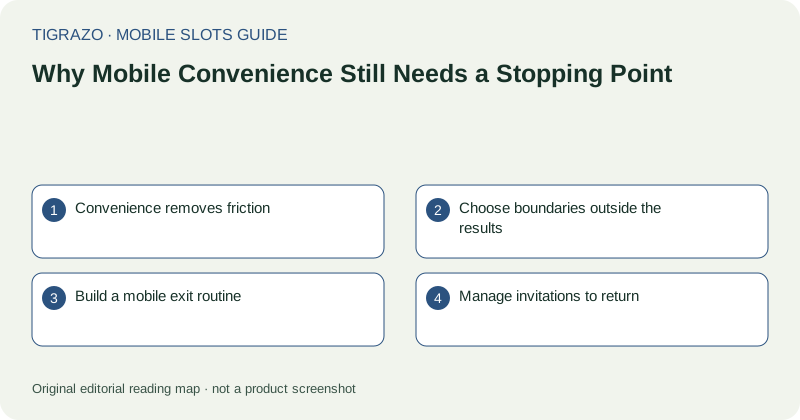
Convenience removes friction
A browser tab can remain available between messages, travel and household tasks. Because reopening it takes little effort, separate visits may feel smaller than the total time involved. The device's portability does not make the activity less consequential.
Notice the difference between deliberately choosing to open information and reflexively returning to the same tab. Neither a restored page nor an idle moment is an instruction to continue. You can close the browser without completing a narrative sequence.
Choose boundaries outside the results
A stopping point should not depend on obtaining a win, recovering an amount or seeing a feature. Those events are uncertain, so using them as exit conditions can extend a session indefinitely. Independent outcomes do not become due because you are ready to leave.
Practical boundaries can involve a pre-set time, a personal spending limit or the arrival of another responsibility. Keep these separate from the game's audio and story. A dramatic transition does not invalidate a boundary already chosen.
Build a mobile exit routine
A clear exit routine makes stopping concrete rather than merely an intention. It should preserve the ability to understand any unresolved activity without requiring another round.
- Stop initiating actions when the chosen boundary arrives.
- Read the settled status or note any unresolved round.
- Check recorded history if the last outcome is unclear.
- Close the game view through normal navigation.
- Sign out where appropriate and put the device aside.
If a connection error prevents verification, record the details and use support. Do not turn technical uncertainty into repeated reloads or additional play.
Manage invitations to return
Browser shortcuts and retained tabs can act as visual reminders even without formal notifications. Organise the device so that leaving means leaving. Available browser or device controls may help reduce unnecessary prompts, but no particular feature should be assumed to exist.
A timer can provide a reminder, yet it is not an automatic guarantee of stopping. Put it where it can be noticed, and avoid repeatedly resetting it because a result feels unfinished.
Understand what a pause accomplishes
A pause restores attention and separates the next decision from the momentum of the last one. It does not improve the next spin's probability or reset the game into a more favourable condition. Its value is behavioural and practical, not predictive.
If limits repeatedly become difficult to follow, stop and seek appropriate gambling-support resources rather than designing more elaborate exit rituals. Mobile convenience should make ordinary life easier; it should not make a session feel impossible to end.